Saturday, May 16th 2026
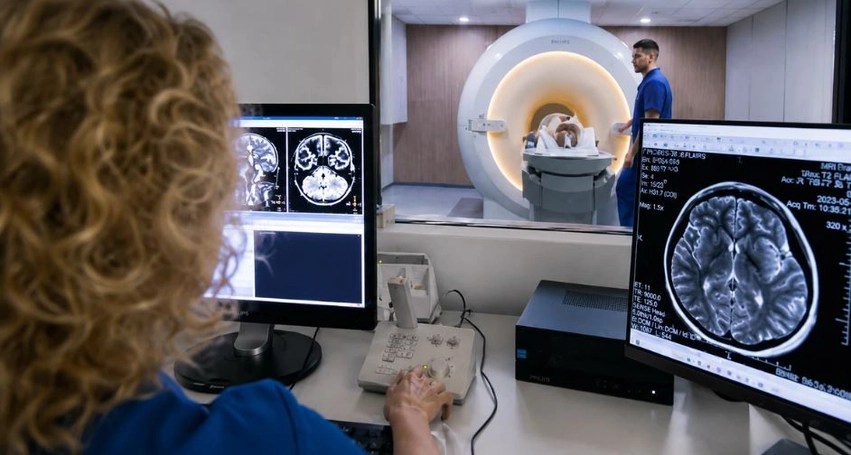
Researchers have developed a new type of magnetic resonance antenna, inspired by metamaterials, which could help capture much clearer images of areas of the body that have until now been difficult to see in detail
According to the Max Delbrück Center, MRI scans often have difficulty producing clear images of deep tissue or very delicate structures, such as certain regions of the brain, the eye and the orbit. Researchers report that the new, lightweight and advanced antenna can improve image quality and shorten examination time without requiring changes to existing MRI machines.
Magnetic resonance imaging is among the most important diagnostic tools in medicine. However, the limitation in some cases is not related to the device itself, but to the device that sends and receives the radio frequency signals. Standard antennas, also known as radiofrequency coils, often fail to collect sufficient signal from deep tissue or areas of complex anatomy. As a consequence, the scans may take longer and the images may not show important details.
The team led by Nandita Saha, a PhD student in the Experimental Ultrahigh Field Magnetic Resonance laboratory of Professor Thoralf Niendorf at the Max Delbrück Center, has created a new MRI antenna, based on advanced materials. The study is published in the journal Advanced Materials.
Niendorf and his colleagues collaborated with researchers from Rostock University Medical Center, bringing together MRI physics, clinical ophthalmology and translational imaging. The Rostock team is also helping to evaluate the technology for clinical use.
“Using concepts from metamaterials, we were able to direct radiofrequency fields more efficiently and show how advanced physics can directly improve medical imaging,” says Niendorf, senior author of the paper.
MRI creates images by sending radiofrequency signals into the body and measuring the response of tissues within a powerful magnetic field. The stronger the signals, the clearer the images. To improve this process, the researchers integrated metamaterials directly into the antenna.
Metamaterials are engineered structures that can manipulate electromagnetic waves in ways that natural materials cannot. The new antenna strengthens signals from target tissues, increases spatial resolution, improves clarity and speeds up data collection. Importantly, it works with existing MRI systems, so hospitals would not need entirely new infrastructure.
The technology was tested by imaging the eye and orbital area in volunteers, in MRI with a 7.0 Tesla magnetic field. According to Professor Oliver Stachs from University Medicine Rostock, the study is of particular importance for ophthalmology, because it enables high-resolution images and anatomical details of the eye. He says this technology could open a new window for observing the eye and physiological and pathological processes that were previously largely inaccessible.
Saha adds that the same technology could also be adapted to protect sensitive areas of the body during MRI, for example by reducing unwanted heating around medical implants. It can also help more precisely focus radiofrequency energy for MRI-guided therapies in cancer treatment, including controlled heating of tumors or thermal ablation of tissue.
MRI exams can be long and uncomfortable for patients, especially when they have to be repeated because important structures are not seen clearly enough. Shorter scans would cut the time patients spend in the machine, while sharper images would help doctors make diagnoses with more certainty.
Researchers are now preparing larger studies at several hospitals and adapting the design for other organs, including the heart and kidneys.
Source: prizrenpost