Sunday, July 5th 2026
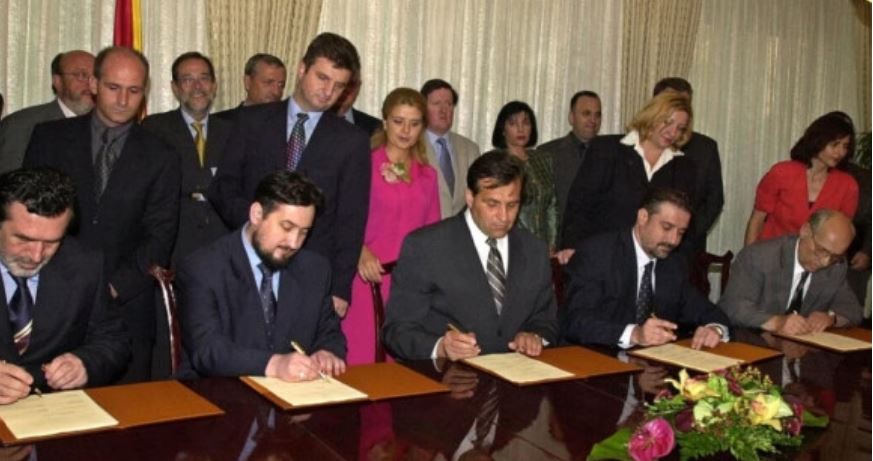
On July 5, 2001, the Government of Macedonia and the Albanian insurgents reach a peace agreement.
With this agreement, it was possible to end the conflict, which ended with the so-called Ohrid Agreement signed on August 13 in Ohrid, Macedonia.
The destruction of the SFRY and the annexation of the Republic of Macedonia caused deep political, social and economic changes at the time. Pluralism manifested itself with the formation of political parties which, instead of an ideological one, had a strong ethnic character.
As a result of this transition, a large part of the population remains unemployed, while poverty, corruption, criminality and the economic crisis take on very large proportions.
The destroyed economy, political affairs and scandals, corruption and deteriorated inter-ethnic relations further destabilized the country.
It should be emphasized that with the Constitution of 1991, Albanians lost the rights they formally enjoyed with the Constitution of 1974. For these reasons, the Constitution was approved without the votes of the Albanian deputies in the Parliament.
The period of 2000-2001 in Macedonia is characterized by high unemployment (400,000 people capable of working are unemployed, while 80,000 families receive social assistance) and with the unfinished privatization process accompanied by bankruptcy procedures for many enterprises.
Political life is characterized by an ethnic party, while the Government was led by a nationalist party. The government was centralized, while the legal system and laws were not completed (the necessary laws had not been approved, while those approved often changed and the courts very slowly decided on cases).
Even though there were Albanian representatives in the Parliament and there were Albanian ministers in the government coalition, in the administration and state structures, Albanians were not proportionally represented. The political parties of the Albanians in the Republic of Moldova continue to publicly show their dissatisfaction with their status in the political and public life of the country.
The tension in inter-ethnic relations comes to the fore during the protests of the Albanians with the request for the increase of collective rights where they are punished and confronted with the police as well as during the protests of the Macedonians against the increase of the rights of the Albanians.
The armed conflict started in the vicinity of the village of Tanushe in Skopje, in February 2001. Combat activities took place in the region of Kumanova and Lipkova, that of Tetova and Skopje.
During the conflict, the KLA attacked the security forces of the Republic of Macedonia, mobilized a part of the Albanian population to participate in the combat activities and activities against the civilian population.
The security forces attacked the KLA positions with weapons of seriously, they prepared ambushes for KLA members, arrested citizens who were suspected of being members and collaborators of KLA, carried out activities against the civilian population. Police checkpoints were set up in and around the crisis regions.
Many people left their homes in the crisis regions and as refugees or as internally displaced, settled in other countries, inside and outside the country.
On both sides there were human casualties, while in the crisis regions there was also material damage to the houses and property of the population, as well as the destruction of religious buildings and cultural-historical.
The international community was active from the beginning of the armed conflict, although its participation was not equal. At first it condemned the activities of the KLA and declared them as terrorists, and later asked the Government and the Parliament to take their demands into account.
Under the influence of the international community, a broad coalition government was formed, consisting of the four largest parties, in which, in addition to VMRO-DPMNE and PDSH, SDSM and PPD also entered.
Through its representatives appointed by the EU and the USA, the international community participated in the formulation of the Framework Agreement and stimulated the signing of the same. Immediately after that, NATO forces observe and are stationed in the territory of the Republic of Macedonia.
The content of the framework agreement for the solution of the political and security situation in Macedonia, which was officially signed in English on Monday by the President of the Republic of Macedonia, Boris Trajkovski, the leader of VMRO-DPMNE and Prime Minister Lubço Georgievski, the leaders of SDSM Branko Cërvenkovski, of PPD Imer Imeri and DPA Arbën Xhaferi. In the document, the international facilitators in the dialogue – Fransoa Leotar and James Perdu – signed as official witnesses.
Source: prizrenpost