Sunday, March 1st 2026
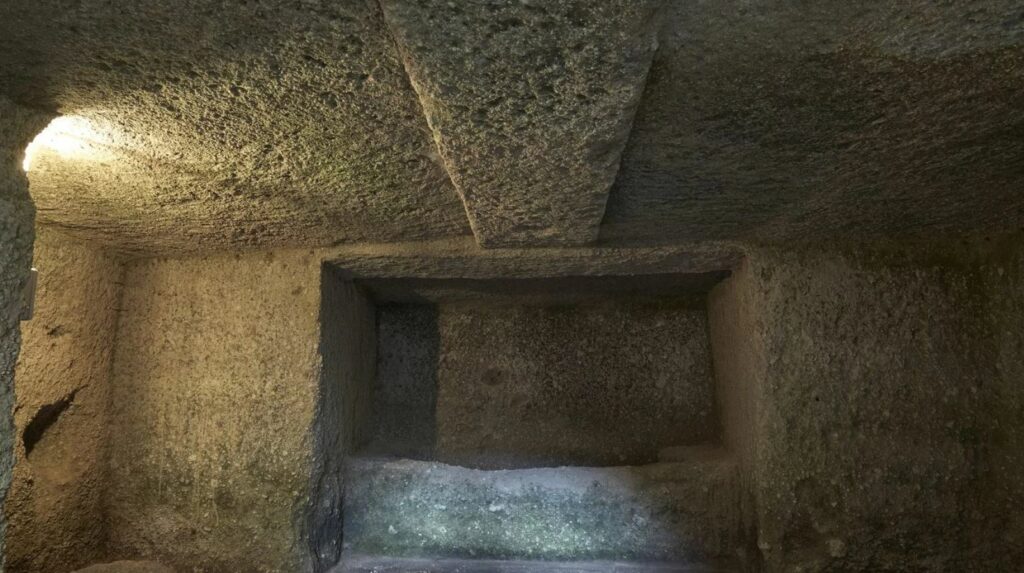
A rare archaeological discovery in Italy has brought to light an Etruscan burial chamber completely sealed for more than 2,600 years, where four skeletons and over 100 funerary objects were found in excellent condition.
The tomb was discovered in the area of San Giuliano, about 70 kilometers northwest of Rome, in a hilly region of central Italy. The archaeological research project in this area is being led by Baylor University researchers, in collaboration with Italian institutions.
According to the archaeologist Davide Zori, one of the project leaders, it is one of the most important discoveries of the last decades to understand the pre-Roman civilization.
“A burial chamber of this age, completely preserved and untouched, has never been excavated before in this region with modern archaeological techniques”, he declared. him.
Inside the tomb, archaeologists found four skeletons placed on carved stone beds. Around them were more than 100 burial objects, including ceramic vessels, iron weapons, bronze ornaments and delicate silver hair accessories.
Preliminary analyzes suggest that the burials may be two male-female couples, however researchers await more detailed laboratory results to confirm their identities and connections.
The San Giuliano research project began in 2016 and so far more than 600 tombs have been discovered in the necropolis surrounding the ancient Etruscan city, built on a rocky plateau.
However, all the other burial chambers, carved into the rock and built in the form of a small house with a sloping roof, had been looted before. Some of them turn out to have been looted since the beginning of the Roman occupation, at the end of the 3rd century BC.
This is the first case in the area where a tomb from this period has been found intact.
Researchers believe that the hundreds of Etruscan tombs carved into the rock around the plateau were connected to the ancient city that was located there.
The project aims to reconstruct the long history of habitation in this area, from the Etruscan period, the incorporation into the Roman Empire, the transformation into a medieval fortress and the final abandonment of the settlement before 1300.
For the students involved in the research, the experience was unique. One of them described the moment as “surreal”, stressing that such discoveries are the dream of every archaeologist.
Experts emphasize that the full study of the discovered materials has just begun and that this intact tomb may offer new and valuable data on the life, rituals and social structure of the Etruscans, a key civilization in the history of Italy before the rise of Rome.
We use cookies to improve the experience and to display ads (Google AdSense).
By clicking “Accept”, you agree to the use of cookies according to
Privacy Policy
and
Cookies Policy.
You can reject non-necessary cookies by clicking “Reject”.
Source: prizrenpost