Saturday, April 4th 2026
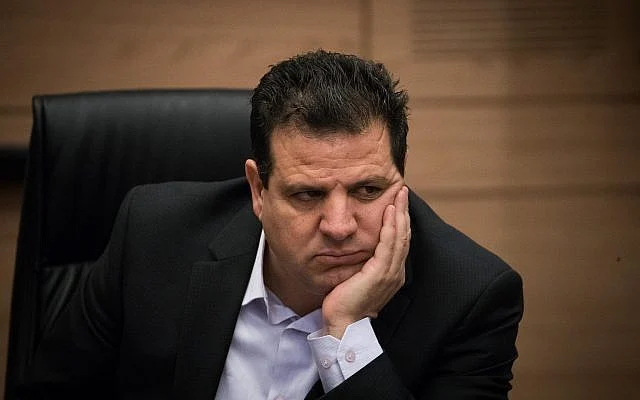
At the beginning of each parliamentary session, Benjamin Netanyahu gave his usual speech. He paraded his own achievements while his servile servants in parliament rose to applaud him at every pause, willfully ignoring his failings. Still, there was always one theme he kept behind a long, deliberate silence—his way of signaling the weight of what he had to say. We already knew exactly what awaited us.
He smiled and confidently declared something like: “They used to say that the Palestinian issue is the root of the conflict. But the real root is the refusal to recognize Israel. The Abraham Accords prove that peace with the Palestinians is not a condition for peace with the Arab world.” And you added: “The real challenge is to achieve peace between Israel and the Arab states.”
We knew that this argument contradicted both reality and logic. However, in recent years, the Palestinian issue has found itself at a difficult crossroads. One by one, several Arab states were normalizing relations with Israel, strongly encouraged by Donald Trump. At that time, we warned clearly: the Israeli occupation would not end until its cost became truly unaffordable for Israel.
Today, no one doubts any more: the occupation has reached a crushing cost.
The latest war began in Gaza, and after two and a half years of shocking losses – both in human life and in resources – its consequences are being felt everywhere. region.
What started in Gaza has now escalated into a wider confrontation between the United States and Israel on the one hand, and Iran (backed by Russia and China) on the other – a conflict with effects that extend far beyond the battlefields. In this galloping crisis, Tehran’s network of regional actors is engaged at various levels, with some militias intensifying attacks while others are avoiding full-scale war.
As a member of the Knesset (Parliament), I attend many committee meetings – and there is not one of them that has not been affected by the occupation, directly or indirectly. The Committee on Foreign Affairs and Defense is the most egregious example. The Finance Committee debates a budget that dramatically strengthens the occupation and colonies, all at the expense of social and economic needs. The Interior Commission faces crime in the Arab community, which the government refuses to take seriously, seeing Palestinian citizens as part of a people it treats as the enemy. While the Constitution Commission, led by settler Simcha Rothman, pushes forward a judicial reform aimed at seizing private Palestinian lands in Area C, without the intervention of the Supreme Court.
This spirit has taken over the entire Knesset.
However, those who suffer the most inside Israel are the country’s Palestinian citizens, who make up about 20% of the population. Their reality is like a tightrope walk: if they lean too much towards national identity, they risk citizenship; if they lean too much towards citizenship, they risk alienating their identity. Since October 7, even this fragile rope has begun to snap.
Thucyditis wrote that “war is a violent teacher”, revealing harsh truths about power, fear and human limits. This lesson is more evident than ever today: the war in Gaza violently exposed the limits of force. At first glance, it seemed that the Israeli right had all the advantages: the most right-wing and most cohesive government in the country’s history; October 7 as a pretext to pursue its full agenda; a war supported by over 90% of Jewish citizens; the longest conflict since 1948; and two more supportive US administrations than ever.
And yet, despite all this, when the war is over, there will still be some 7.5 million Palestinians and 7.5 million Israelis sharing the space between the Jordan River and the Mediterranean Sea. This reality has not changed – and will not change.
After the wars of 1948 and 1967, the vast majority of Israeli Jews felt the triumph, while the Palestinians suffered the humiliation of defeat. This war is different. Ask Israelis and Palestinians today if they would like to return to October 6, 2023; most would probably say yes without hesitation. This alone proves the profound transformation of the political and human landscape in the region.
Even the conflict with Iran – another derivative of the unresolved Palestinian issue – has revealed something else: the US and Israel have found it almost impossible to achieve their goal of regime change.
Everything that has happened during these two years shows that the Middle East will remain a hotbed of cyclical outbreaks of violence. And at the center of this instability lies the unresolved Palestinian issue.
That is certainly not the solution proposed by the Israeli right, which has repeatedly failed. Just a year ago, it claimed that Hezbollah had been annihilated – and yet the group remains a formidable fighting force. The same thing happened with Hamas, and with other Palestinian leaders who were eliminated over the years.
For the Zionist left, the defining event of the last three decades was the Oslo Accords. For the Israeli right, the primordial event is October 7 and this war.
If after Oslo the right attacked the left claiming that peace did not bring security, today we can attack the right arguing that neither the military approach brought a solution nor security.
The two peoples should not choose death alone, but life – either together or apart. They must recognize the other’s existence and choose life.
An idea cannot be defeated by military force alone. Ideas are only challenged by better ideas. The only truly convincing idea is one that recognizes the national rights of both peoples and guarantees self-determination for each.
I believe that the Arab Peace Initiative of 2002 remains a realistic and achievable framework. Its principle is simple: Israel recognizes the Palestinian state and, in return, ensures peace and normalization with the entire Arab and Muslim world.
Even if some groups or states were to oppose it, the moment the Palestinians themselves – those who are subject to this right, including the PLO and the Palestinian Authority – would accept it, there would no longer be any practical basis for rejecting it.
After two and a half years. exhaustion, what we need is an ethical and courageous choice: peace based on the rights of both peoples.
On October 7, the Palestinians hit Israel like never before in a century of conflict. But the result is that the State of Israel survived. After October 7, the Israelis hit the Palestinians with unprecedented ferocity. But the result is that the Palestinian people did not give up.
Both peoples must give up the path of death. They must accept each other and choose life.
The views expressed in the article are the author’s and do not necessarily represent the editorial positions of Tesheshi.com.
*Ayman Odeh is a Palestinian citizen of Israel and the chairman of the Hadash–Ta’al List in the Knesset.
We use cookies to improve the experience and display advertisements (Google AdSense).
By clicking “Accept”, you agree to the use of cookies according to
Privacy Policy
and
Cookies Policy.
You can reject non-necessary cookies by clicking “Reject”.
Source: prizrenpost