Saturday, April 11th 2026
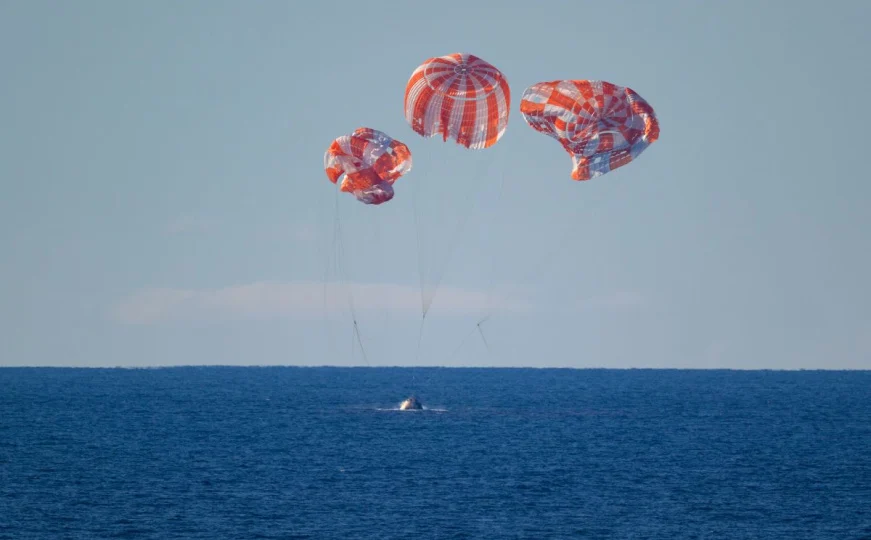
The Artemis II capsule with a crew of four has successfully returned to Earth and landed in the Pacific Ocean after almost ten days in space, ending the first human trip near the Moon in more than half a century.
NASA’s dome-shaped Orion capsule, named Integrity, parachuted safely into calm waters off the coast of Southern California shortly after 5:07pm local time (00:07 GMT Saturday). The mission took the astronauts four days ago to a distance of 252,756 miles from Earth, deeper into space than anyone had flown before.
The Artemis II flight, which covered a total distance of 694,392 miles (1,117,515 kilometers), included two Earth orbits and a key flyby of the moon about 4,000 miles above its surface. It was the first manned test flight of the Artemis program, which aims to return astronauts to the moon by 2028, Reuters reported.
The landing went smoothly and NASA described it as “perfectly accurate”. Mission Commander Reid Wiseman confirmed immediately after landing that all crew members were stable and in good condition.
Big smiles from Christina and Victor on the deck of the USS John P. Murtha, as they waited to be escorted for their routine post-mission medical checks. pic.twitter.com/3KwZFXTLhI
NASA and US Navy teams secured the capsule in less than two hours and extracted the crew, consisting of American astronauts Reid Wiseman, Victor Glover and Christina Koch, as well as Canadian astronaut Jeremy Hansen.
The return to Earth was the most dangerous part of the mission, during which the durability of the capsule’s heat shield was tested. Orion entered the atmosphere at a speed 32 times greater than the speed of sound, while the temperature on the surface of the capsule reached about 2,760 degrees Celsius. During re-entry, there was a planned communication interruption that lasted more than six minutes.
The crew module on Orion has separated from its service module. After traveling around the Moon, seeing its far side, and experiencing a solar eclipse, the Artemis II astronauts are on the last leg of their trip home. pic.twitter.com/j9u5j1Noi9
After reestablishing contact, the parachutes successfully slowed the capsule before it gently landed on the ocean surface. The astronauts were then transferred by helicopter to the USS John P. Murtha, where they underwent medical examinations.
Orion’s main parachute has deployed. The spacecraft has a system of 11 chutes that will slow it down from around 300 mph to 20 mph for splashdown.
Get more updates on the Artemis II blog: https://t.co/7gicm7DWBt pic.twitter.com/ReXHTfkFld
The mission began on April 1 with a launch from Cape Canaveral, Florida, when the crew lifted off aboard the Space Launch System rocket of NASA. During the flight, they also visited the far side of the Moon, becoming the first astronauts to do so since the Apollo missions of the 1960s and 1970s.
The mission represents an important step toward NASA’s future plans to return humans to the Moon, and also in preparation for the long-term goal of sending a human crew to Mars.
We use cookies to improve the experience and display ads. (Google AdSense).
By clicking “Accept”, you agree to the use of cookies according to
Privacy Policy
and
Cookies Policy.
You can reject non-necessary cookies by clicking “Reject”.
Source: prizrenpost