Friday, April 17th 2026
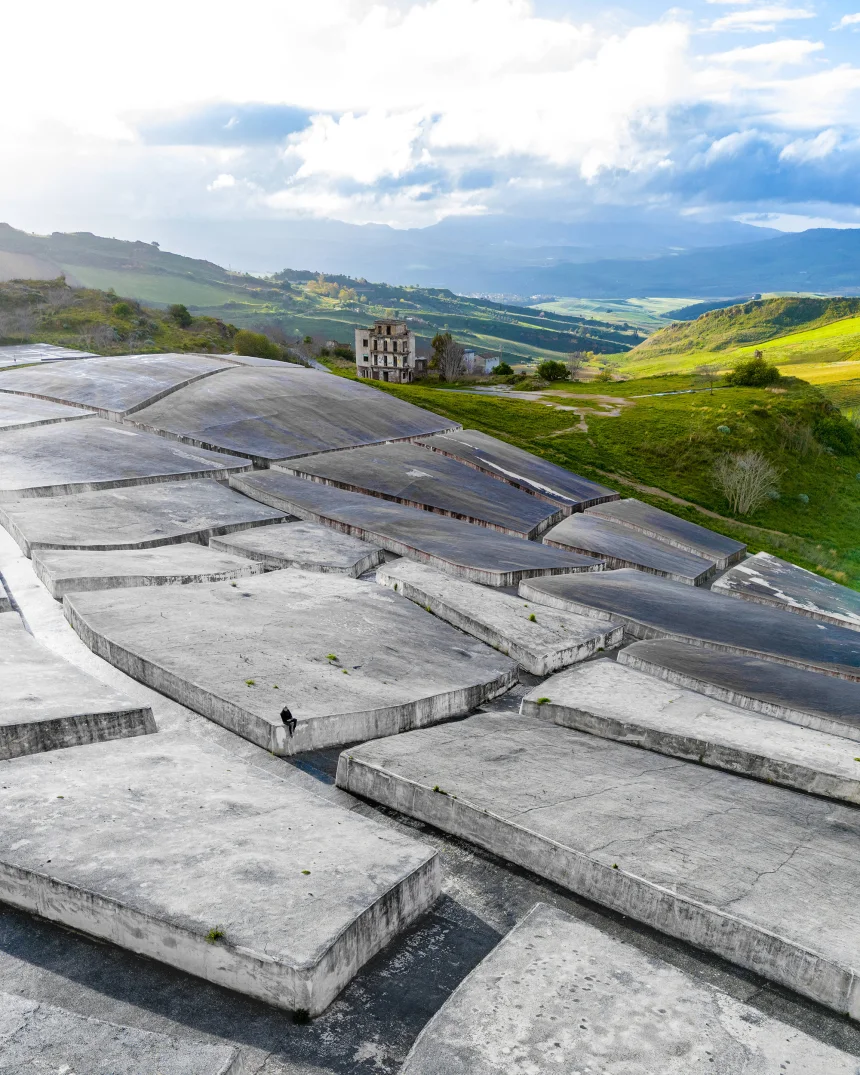
In the heart of wild Sicily, far from the touristy beaches and the noise of big cities, lies a scene that resembles a science fiction scenario or a surrealist vision.
An entire hillside is completely covered by 926,000 square meters of gray concrete. This gigantic work, known worldwide as the “Grande Cretto”, is one of the largest art installations on the planet and serves as a blanket of cement that protects the memory of an indelible tragedy.
This “modern Pompeii” was not created by volcanic ash, but by the despair of a catastrophic earthquake in January 1968, which completely leveled the old city of Ghibellina inside seconds, leaving behind only ruins and thousands of lives lost or displaced elsewhere.
Instead of clearing the ruins to build something new on top of them, visionary artist Alberto Burri decided to freeze them eternally in time.
He conceived a project where tons of concrete would be poured over the blocks of ruined houses, while the deep channels that run through this gray mass follow with surgical precision traces of former streets where children once played and neighbors chatted under the scorching rays of the Sun.
Today, visitors walking through these concreted cracks feel a monumental weight of silence, as the high walls that surround them represent the frozen skeletons of a community that no longer exists physically, but refuses to be forgotten.
But Ghibellina’s story does not end on that gray hill. It was reborn half an hour away and in a form that would amaze the world of art and architecture.
Under the leadership of the rebellious mayor Ludovico Corrao, who refused to leave his people in oblivion or surrender to poverty, Nuova Gibellina was designed as an experimental city where architecture and contemporary art would serve as a means of healing the souls of the inhabitants.
The urban plan of the new city was conceived as something completely “alien” to the Sicilian tradition: extremely wide streets intended to prevent damage from future earthquakes and avant-garde buildings that defied all logic of the time.
The city was filled with over five thousand five hundred works of art by the biggest names of the 20th century, such as Joseph Beuys, Philip Glass and Arnaldo Pomodoro, transforming this town of only three thousand inhabitants into a giant gallery under the sky open.
However, this renaissance came at a psychological cost, as residents who had been living in old stone houses suddenly found themselves in a brutal and abstract environment, where every street corner was a sculpture and every church resembled a futuristic sphere or pyramid.
Today, as Gibellina prepares to be Italy’s first Capital of Contemporary Art for 2026, it remains an open laboratory of the relationship between man, disaster and beauty.
This city proves that even when the earth shakes and everything collapses, art remains the only language that can give meaning to destruction and turn a ruin into an immortal monument of the human spirit. /tesheshi.com/
We use cookies to improve the experience and to display ads (Google AdSense).
By clicking “Accept”, you agree to the use of cookies according to
Privacy Policy
and
Cookies Policy.
You can reject non-necessary cookies by clicking “Reject”.
Source: prizrenpost