Sunday, May 10th 2026
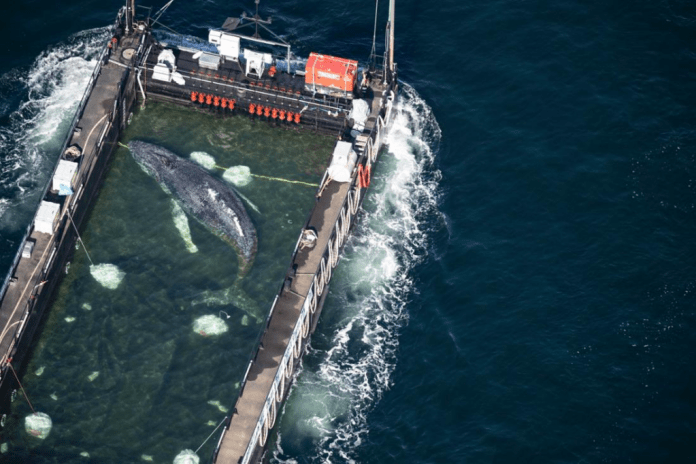
The whale Timmy or Hope is already on the way to freedom in the waters of the North Sea.
A case that attracted the attention of the whole public opinion, when a whale got stuck in shallow waters on the German coast of the Baltic Sea. The operation to save her was quite difficult due to the complexity of pulling and moving the “giant” of the sea, in order not to injure her, but also due to the size, as well as the initial problems in the political context and the extraordinary social impact.
The great social interest in saving the ocean mammal was successful.
Man’s relationship with whales is ancient. Despite their extraordinary dimensions, they are not at all dangerous for us, but the opposite is true. They feed on tiny creatures called krill, which are very, very small sea crustaceans, which they consume by the ton.
Among their species, the blue whale is the largest creature to have ever existed on Earth. It reaches up to 33 meters in length and weighs about 170 tons.
They are quite interesting animals and among the longest-lived mammals, where one species can reach up to 200 years.
In human culture, the whale symbolizes wisdom, mystery and strength.
Whales are essential for the marine ecosystem. Their feeding behavior affects ocean cycles, and rising to the surface affects the distribution of iron and nitrogen, which stimulate the growth of phytoplankton, which are the base of the marine food chain. Phytoplankton also absorb very high amounts of CO₂, up to 40% produced. These microorganisms are among the most important for the balance of the planet, as they also produce 50% of the oxygen in the atmosphere.
The heart of an average specimen weighs about 180 kg, and its beating can be heard up to 3 km away, while the tongue weighs 2.7 tons.
When the blue whale opens its mouth, it can hold up to 90 tons of water and food.
It also holds the record for the slowest heart rate among mammals, where at rest the heart performs an average of 5-10 beats per minute, while when submerged in the depths of the ocean it reaches only 2 beats per minute, a very low rate that is a mechanism to preserve oxygen while the animal stays submerged for a long time.
Whales are known for their communication language and songs, which are actually songs. love, as well as for going out of the water, jumping and pirouettes in the mating season. Males during the courtship season produce articulate and complex sequences of sounds that have the function of attracting females, even if they are located at long distances of many kilometers.
Their acoustic repertoire includes songs, social calls related to feeding or caring for young, and communication of individuals.
According to numerous studies, whale songs follow structural rules similar to human language, with parts organized into way to facilitate learning and cultural transmission between generations. Whales, orcas and dolphins not only communicate with each other, but also develop dialects that vary based on social group and geographic location. Currently, it is decided to use artificial intelligence to help decipher the “dictionary” of the giants of the seas.
Sexual maturity of whales is reached on average at the age of 8 years and there is usually an interval of 2-3 years between births. Females of the species are fertilized in winter with a pregnancy that lasts about a year.
Pregnancy is completely synchronized with the annual migration and the birth process, after finding a suitable environment, is quite fast.
The young at birth are generally about 4 meters long and weigh more than 1 ton, while the mother continues to care for the newborn by feeding it with about 550 liters of milk a day for months. whole. When the nursing period ends after many months, the first migration begins towards colder waters, which usually have more food, while in warm waters the journey takes place for reasons of reproduction.
These spectacular animals that populate all the oceans of planet Earth have been in danger of extinction for many decades. Man is their biggest threat, as whaling has been a tradition for centuries. It is an old practice, mainly started in coastal communities and has been used for food, for oil and materials for tools and various uses.
Whale oil obtained from their fat or blubber was used for lighting with lamps, lubricants, as well as in the creation of soaps, cosmetics and perfumes.
The concerns at the global level for the conservation of the species are also environmental pollution, noise pollution, pollution from plastic, the acidity of the oceans, their getting stuck in shallow waters or colliding with ships. Until the beginning of the 20th century, the blue whale was very widespread in the oceans. For more than 40 years it was hunted in an extreme manner, until it almost touched extinction.
The international community declared it a protected species in 1966 and in 1982 a moratorium was placed on whaling to protect these very important species.
According to one report, it is thought that in 2002 there were a total of 5,000-12,000 specimens in the world. While before wild hunting, the largest population of whales was the Antarctic, with about 239 thousand individuals.
Today the whale populations are very small, with groups of about 2 thousand specimens, mainly concentrated in the Pacific, Atlantic and Indian Oceans, while smaller populations swim in the southern hemisphere and the northern Atlantic.
We use cookies to improve the experience and display advertisements (Google AdSense).
By clicking “Accept”, you agree to the use of cookies according to
Privacy Policy
and
Cookies Policy.
You can reject non-necessary cookies by clicking “Reject”.
Source: prizrenpost