Friday, April 17th 2026
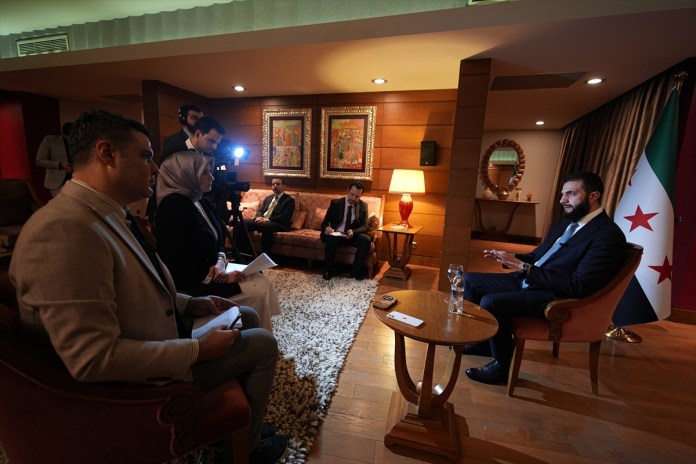
Talks with Israel have not reached a dead end, but are continuing with “great difficulties” due to Israel’s insistence on remaining on Syrian territory, Syrian President Ahmad al-Sharaa said, stressing that Syria is “serious” about reaching a security agreement that preserves regional stability.
In an interview with Anadolu, al-Sharaa added that Israel is “acting with great brutality” and occupying areas near the Heights. of the Golan, while Damascus “has chosen the diplomatic path” to avoid escalation.
Regarding relations with Turkey, he said that the partnership between the two countries “will shape the future of regional and global security”.
Turkey stood by the oppressed Syrian people for 14 years, the Syrian president added, confirming that the two countries share “deep historical and geographical ties”.
Below are excerpts from his interview with Anadolu within the Diplomacy Forum in Antalya:
Question: This is your second participation in the Diplomacy Forum in Antalya. What can you say about the current direction of Syria-Turkey relations? Can you elaborate on key projects such as industrial zones in Idlib, employment opportunities and the return of displaced persons?
Answer: Syria and Turkey share deep historical and geographical ties. During the period of the previous regime, Syria was isolated from the regional and international community. The liberation of Syria created a new opportunity for rebuilding these relations, especially with Turkey, which stood by the Syrian revolution for 14 years and supported the oppressed people throughout this time.
Syria has been transformed from a crisis to a land of various opportunities. We have tried to emphasize these possibilities during our repeated visits to Turkey and other countries. There are significant opportunities for regional integration between Syria and Turkey, as Syria serves as a bridge between East and West. Work is currently underway to create a Syrian-Turkish free zone in the Idlib region, where several industries can be developed together. The area is located along the main roads connecting Idlib, Latakia, Aleppo and Damascus.
We are also working on expanding airports, investing and connecting ports, as well as rebuilding infrastructure. Turkish companies are already active on the ground in the reconstruction of Syria.
Question: The recent war between the US and Israel on the one hand and Iran on the other has caused a global energy crisis. The world is looking for alternative supply routes and regional connectivity. What are the opportunities and challenges for Syria in this regard?
Answer: Syria has emphasized the importance of Syria’s strategic position since we came to Damascus last year, but the world really felt this need after the outbreak of the war involving Iran and the disruption of global energy supplies. Syria represents a safe corridor and an alternative route for energy supplies and supply chains — especially the links being developed between the Arab Gulf and Turkey, which pass through Syria and Jordan simultaneously. Syria’s access to the Mediterranean makes it an excellent and secure link between the eastern and western chains.
This is already beginning to take shape. According to a joint agreement between Syria and Iraq, Iraqi oil has begun to be exported through Syrian ports. The stable relations between Turkey, Syria, Jordan and the Gulf countries are a great asset here. The main challenge remains maintaining stability and neutrality in the region amidst the surrounding conflicts.
Question: Is the Four Seas Project part of this framework?
Answer: Yes, it is part of this wider chain of regional integration and reconnection of trade routes. What the world is looking for most urgently now is the security of supply chains and energy. This integration — linking Azerbaijan and the Caspian Sea, Syria and Turkey to the Mediterranean, and the Gulf’s access to the Red Sea and the Arabian Gulf — fits precisely this need.
Question: At what stage have security contacts with Israel, brokered by the US, reached? How likely is a consensus? And what is your reaction to Israeli Prime Minister Netanyahu’s statement linking Israel’s presence in Lebanon to reaching out to the Druze community in Syria?
Answer: After 14 years of devastating war against the previous regime, Syria’s policy is focused on development and reconstruction — and that requires stability. Israel has responded with great brutality, striking many Syrian facilities, violating Syrian sovereignty and occupying parts of the territory near the Golan Heights, which are already occupied. We have chosen the diplomatic path and are working to convince the international community to stop the escalation, especially after the great fatigue of the Syrian people during 14 years.
We are serious about reaching a security agreement that preserves regional stability. Syria has passed from a state of crisis and the international community is beginning to see it as a source of regional and global stability, because the world has seen how Syria was in crisis and is also seeing what it can achieve in this short period.
Negotiations have not reached a dead end, but are continuing with great difficulty due to Israel’s insistence on remaining on Syrian soil.
As for the ongoing war in Lebanon, there are many other solutions that do not involve a direct strike. of buildings and infrastructure. Lebanon cannot afford a conflict of this magnitude. Linking these developments to the south of Syria poses a major threat to regional security, not only to Syria.
Question: Where is Syria currently in the process of national integration? Is there still a long way to go?
Answer: Considering where Syria was before we came to Damascus last year and where it is today, I think we have achieved a lot this year. The revolutionary forces, which were fragmented, have been unified. The integration of SDF forces is ongoing and progressing well. Today, the last foreign military base in northeastern Syria has been liberated and the merger of SDF forces with the Syrian state is being completed. What has been achieved so far is a great success and has greatly contributed to the stabilization of the situation in Syria.
Question: In light of the recent visit of Ukrainian President Volodymyr Zelenskyy to Syria, in which areas can Syria-Ukraine cooperation be developed?
Answer: First, there is a historic partnership between Syria and Ukraine, mainly in food and energy. Ukraine has vast experience in agricultural production, agro-pharmaceuticals and related fields. Syria is essentially an agricultural country and needs a lot of development and skills in this sector. The main partnership being considered is the creation of a center in Syria for the redistribution of food goods through Syrian ports.
Question: Do you have a message for the world through Anadolu Agency and your participation in the Diplomacy Forum in Antalya?
Answer: Turkey, through initiatives like this forum, is contributing to global and regional stability. Turkey’s role in the region and in the world has grown significantly, and the Syria-Turkey partnership is something the region and the world can build on for future security and prosperity.
My message to the world is this: Syria has transformed from a state of crisis to a great historical opportunity — an opportunity for stability, building and reconstruction.
We use cookies to improve the experience and to display ads (Google AdSense).
By clicking “Accept”, you agree to the use of cookies according to
Privacy Policy
and
Cookies Policy.
You can reject non-necessary cookies by clicking “Reject”.
Source: prizrenpost
Etiketa: Brief