Sunday, May 10th 2026

Catholic Church, amid turbulent geopolitics and changing religious course
He wears more formal and traditional clothes than his predecessor, and besides, Pope Leo XIV, unlike Pope Francis, still lives in the Apostolic Palace high above St. Peter’s Square in the Vatican. Also, something Francis never did, he occasionally retreats to the papal summer residence of Castel Gandolfo.
When it comes to outward appearances, American Cardinal Robert Prevost, who was elected head of the Catholic Church by conclave on May 8, 2025 and took the name Leo XIV, behaves in many ways differently from his predecessor.
It is open to where this pope is leading the Church. theologically
However, when it comes to programmatic theological and ecclesiastical-political direction, its direction is still unclear. Until now, there is no encyclical, no major teaching document from Leo’s pen, Augsburg church historian Jörg Ernesti emphasized in an interview with DW. Thus, “it remains open where this pope is leading theologically”. It seems that he is still consciously hiding.
The first words that Leo spoke on May 8, 2025, a few hours after the election from the lodge of St. Peter’s Basilica, were: “Peace be with you all!” No term appears more often in that speech than the word “peace.” Leo supported “an unarmed and disarming, humble and persistent peace”. In doing so, he largely followed the line of his predecessor, who spoke several times about the Russian attack on Ukraine and the conflict in Gaza.
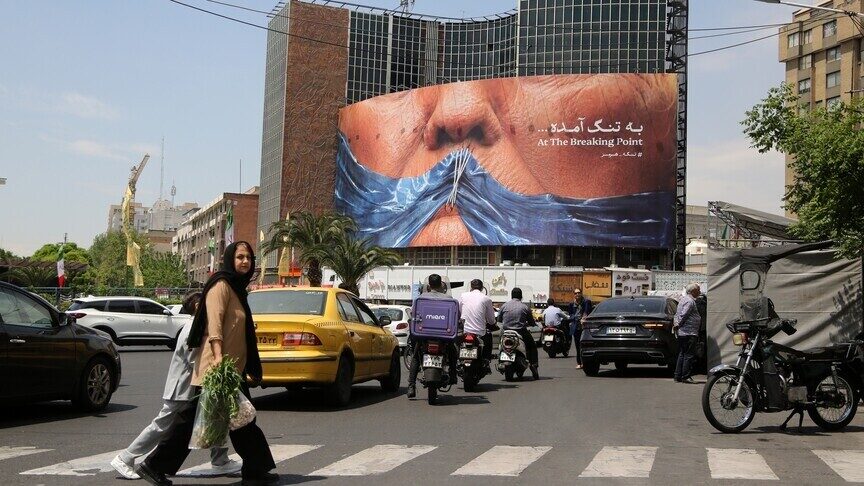
The especially militarized foreign policy of the US President, Donald Trump, gives the peace motive additional importance: the US intervention in Venezuela, the threats to Cuba and Greenland, and the war against Iran. Recently, the attack on Iran, whose pursuit of nuclear weapons has been a cause of international concern for years, led to an open conflict between the two most important Americans in the world at the moment: the Pope, who usually speaks carefully, and the President, who acts with a firm voice.
In the war with Iran, Trump openly threatened to destroy Iran after Easter. “All civilization will disappear tonight,” he said. When the Pope dismissed the threat as “truly unacceptable” and warned of “fantasies of omnipotence” that are becoming “more and more unpredictable and aggressive”, Trump attacked him personally. He called it “very left-wing” and, in terms of foreign policy, “terrible”. Perhaps Trump is ignoring the importance of Venezuela and Cuba, but also Lebanon, to the Catholic Church. All three countries have a Catholic tradition.
Attack on the Pope: “Neither Hitler, nor Mussolini, nor Napoleon”
Church historian Ernesti, who has written numerous books on the papacy and individual popes, calls Trump’s attack on Leo unprecedented. “No one spoke so disparagingly of the Pope. Not even Hitler, not Mussolini, not Napoleon.” It is also “absolute nonsense” to oppose a moral authority like the Pope. According to Ernesti, he reacted very wisely and calmly asked for his service. Later, Leo told reporters on the plane to Africa that he was not afraid of Trump.
The attack by the US president led to the critical statements of the head of the Church, made in a short speech one evening in Castel Gandolfo, receiving worldwide attention. The fact that some countries in the Western world, including the US, have received reports of a renewed interest in religion and the Church in recent months may also contribute to this.
US Vice President JD Vance’s controversy with the Pope attracted less attention. In principle, however, it may have been more important to Leo than the president’s outbursts. Vance, who converted to Catholicism only in 2019 and leans more toward reactionary theological thinkers, asked the pope to be careful when talking about theology. It would be better for “the Vatican to stay on moral issues”. Vance later softened his tone.
So far, no objections to Europe
Unlike his predecessor, Pope Leo’s previous speeches and statements cannot be read as criticism of Europe or the Church in European countries. Pope Francis has occasionally used harsh words and accused Europe of being tired and closed. So far, when hosting representatives of European countries, Leo has always been kind. In June, he is scheduled to visit Spain for six days.
However, it can be seen that Africa is particularly close to him both in his heart and in his attention. In April 2026, he spent eleven days in four African countries. Thus, he stayed longer in Africa than Benedict XVI during his eight years of pontificate. Since the beginning of his pontificate, he had thought about traveling to Africa, Leo said more than once.
For papacy expert Ernesti, this “very conscious decision by Leo” fits into a wider context. For 150 years, Africa has been “in the focus of the popes”. Today, the Church in Africa is growing at an average of three percent per year, while the European Church is stagnating. “The centers of gravity within the Catholic Church are shifting,” says Ernest. More and more Africans are working in the Vatican. This focus and appreciation on the part of the Pope certainly also applies to his view of Asia and Latin America.
Since the conflict between US President Trump and the Pope, many observers no longer expect the Chicago-born Leo to visit the US during the Trump years. The Vatican is responding to rumors that the US administration would like to see the head of the Church in celebration of the 250th anniversary of the US Declaration of Independence on July 4. On the very day when Americans around the world celebrate their country, Pope Leo visits the Mediterranean island of Lampedusa.
Lampedusa has been considered a symbolic place for migration and the plight of refugees since the summer of 2013, when Pope Francis, a few months after the election, visited the island and mourned the thousands of refugees who died trying to cross the dangerous route to Europe. Lampedusa is also programmatically important for Leo. And he emphasizes the suffering of millions of people who are forced to flee around the world.
This is evident in the program of his visit to Spain. The last two days of the trip take him to the two Canary Islands, Gran Canaria and Tenerife. Both are popular tourist destinations where more and more refugees from Africa are arriving by boat. Leo will pay attention to them too. In the favorite destinations of European tourists, the Pope will remember that migration and the fate of refugees are still important topics, writes DW.
We use cookies to improve the experience and display ads (Google AdSense).
By clicking “Accept”, you agree to the use of cookies according to
Privacy Policy
and
Cookies Policy.
You can reject non-necessary cookies by clicking “Reject”.
Source: prizrenpost
Etiketa: Brief