Sunday, May 17th 2026
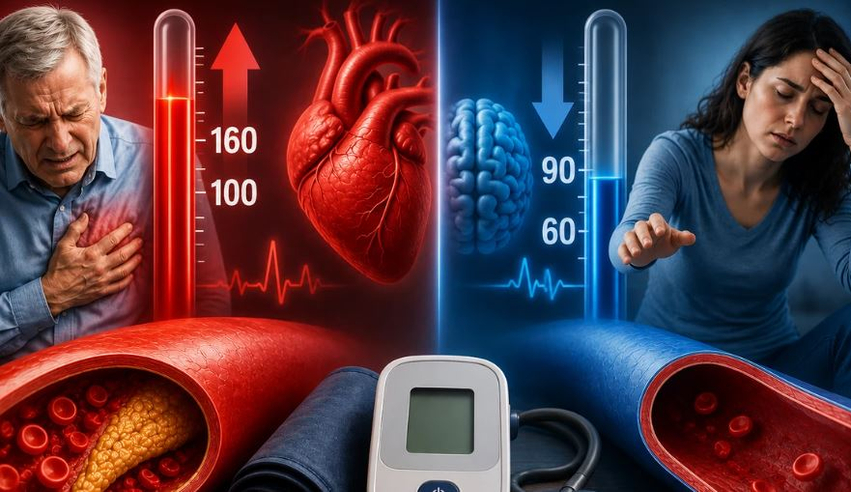
It doesn’t matter if the upper or lower voltage “jumps”. The risk depends on the values, the symptoms, the repetition of the measurements and the general state of health
Blood pressure is one of the most important indicators of the health of the heart and blood vessels. However, many people still interpret it incorrectly: some are afraid when the upper and lower blood pressure “get close”, some are only concerned about the upper value, while others underestimate the low blood pressure.
According to the World Health Organization, hypertension is considered when the blood pressure is 140/90 mmHg or more. It is common, often asymptomatic, and can be serious if left untreated. The only way to know is to measure your blood pressure regularly.
The upper, systolic blood pressure shows the pressure in the blood vessels when the heart pumps blood. The lower pressure, diastolic, shows the pressure when the heart is at rest between two beats. Both values are important and neither should be seen in isolation from the other.
Why should we not only be afraid of the “closeness” of numbers?
One of the most widespread misunderstandings is the fear that it is very dangerous when the two values ”get close”. Indeed, more important is how high the real values are. It is not the same to have 170/110 mmHg and 130/90 mmHg, even if the difference between the two numbers looks similar.
Blood pressure is not a fixed value. It can fluctuate during the day due to stress, fatigue, physical activity, anxiety, insomnia, caffeine, smoking, certain drugs and associated diseases. For this reason, the doctor does not rely only on a single measurement, but evaluates age, symptoms, medical history, therapy and general cardiovascular risk.
Very high values such as 170/115, 170/120 or more are of concern, especially if they are repeated. Very high diastolic pressure indicates that the blood vessels remain under great strain even when the heart relaxes. This can increase the risk of damage to the heart, brain, kidneys and blood vessels.
The American Heart Association states that values above 180/120 mmHg are considered a hypertensive crisis. If they are accompanied by chest pain, difficulty breathing, weakness, numbness, slurred speech, back pain, or vision changes, urgent help should be sought.
Why is hypertension called the “silent killer”?
Hypertension rarely comes alone. It is often associated with arrhythmias, coronary heart disease, heart failure, diabetes, obesity, blood lipid disorders, and kidney problems. For this very reason, high blood pressure should not be treated as an isolated number, but as part of the overall risk to the heart and blood vessels.
For long-term health, high blood pressure is usually more problematic, because it can slowly damage vital organs without giving clear symptoms. It is precisely for this reason that it is known as the “silent killer”.
When is low voltage not harmless?
Even low voltage should not be underestimated. In some people, lower values may be normal, especially if there are no symptoms. The Cleveland Clinic defines low blood pressure usually as a value below 90/60 mmHg, but notes that clinical significance is highly dependent on symptoms and cause.
Low blood pressure becomes worrisome when accompanied by dizziness, lightheadedness, blurred vision, fainting, severe fatigue, confusion, nausea, or an irregular heartbeat. The American Heart Association warns that very low blood pressure can be dangerous when it causes symptoms, because it can indicate that the body is not getting enough blood.
What are the most common causes of low blood pressure?
The causes can be different: dehydration, blood loss, serious infections, heart disease, hormonal disorders, anemia, and the use of certain drugs. The Mayo Clinic points out that low blood pressure is often not a problem if it does not cause symptoms, but in some cases it can be life-threatening, depending on the cause.
A common form is orthostatic hypotension, when blood pressure drops after rising from a sitting or lying position. This may cause dizziness, blurred vision or fainting. In the elderly, the main risk is falls and injuries, but frequent episodes can also signal more serious health problems.
Which is more problematic: high or low blood pressure?
In general, high blood pressure is more problematic for long-term health because it can slowly damage the heart, brain, kidneys and blood vessels without causing symptoms.
However, very low blood pressure with symptoms may be more urgent in the moment. when it happens. If it is accompanied by fainting, confusion, chest pain, difficulty breathing, cold skin, severe weakness or signs of shock, it requires immediate medical help.
For home measurements, a single value of 140/90 mmHg or more is not always enough for a definitive diagnosis, but it is a signal to consult a doctor. The European guidelines rate the measurement at home as useful, because it helps to avoid the “white coat” effect, when the tension increases only in the office.
It is best to measure the tension at rest, after a few minutes of rest, with a suitable cuff and on the same hand. The values should be recorded for several days and presented to the doctor, especially if high or very low measurements are repeated.
Conclusion: don’t just look at the numbers, but also the symptoms
Don’t panic just because the upper and lower voltage are “closer”, but don’t underestimate the high values. High blood pressure is usually the biggest long-term risk, while low blood pressure becomes dangerous when it occurs suddenly, is accompanied by symptoms or is related to a serious health condition.
Measure blood pressure regularly, record the values and consult a doctor, because both hypertension and hypotension, when assessed in time, can be much better managed.
Source: prizrenpost