Saturday, April 25th 2026
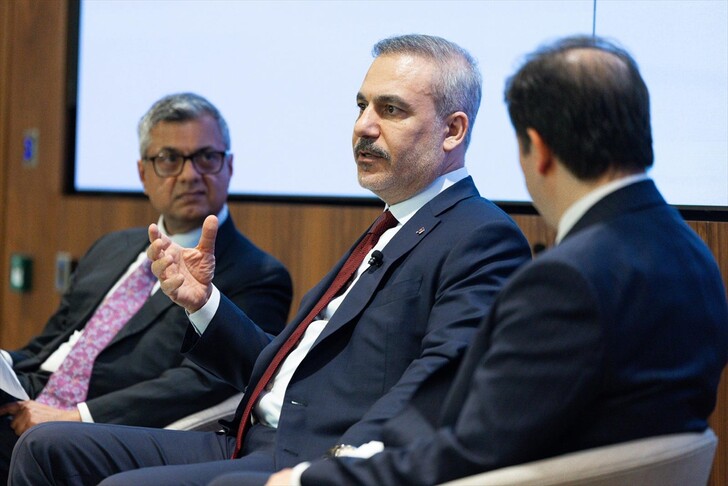
Turkish Foreign Minister Hakan Fidan said that Israel has become a “direct threat to global security” and called for a “collective” international response, stressing that growing instability can no longer be seen only through a regional perspective, Anadolu reports.
Speaking at Oxford University on global realignment, Fidan said the world is experiencing not just a geopolitical transition, but a deeper transformation.
“What what we are witnessing today is not a transition, but rather a transformation,” he said, adding that states can no longer “delegate their security, diplomacy or strategic imagination”.
Referring to the war with Iran, which began with attacks by the US and Israel, Fidan said the conflict dealt “a severe blow to global prosperity, security and stability”.
“Israel’s systematic threat to destabilize the region has exceeded local borders and now poses a direct threat to global security”, he said, adding that such actions “require a collective response from the entire international community”.
Fidan also said that “the distinction between regional and global crises has really disappeared”, underscoring that conflicts can no longer be treated as isolated.
He stated that such uncertainty has increased the importance of middle powers, describing them as states with “strategic geography”, diplomatic reach and political will to produce results.
Fidan highlighted Turkey’s geographic position, institutional reach as a NATO member and EU candidate, and mediation efforts – from the Black Sea grain initiative to diplomacy in the Horn of Africa – as examples of Ankara’s role in crisis management.
He also called for global institutional reforms and a regional order in the Middle East based on cooperation and not in “dominance or submission”, supporting “regional solutions to regional problems by countries in the region”.
We use cookies to improve the experience and display ads (Google AdSense).
By clicking “Accept”, you agree to the use of cookies according to
Privacy Policy
and
Cookies Policy.
You can reject non-necessary cookies by clicking “Reject”.
Source: prizrenpost
Etiketa: Brief