Thursday, February 19th 2026
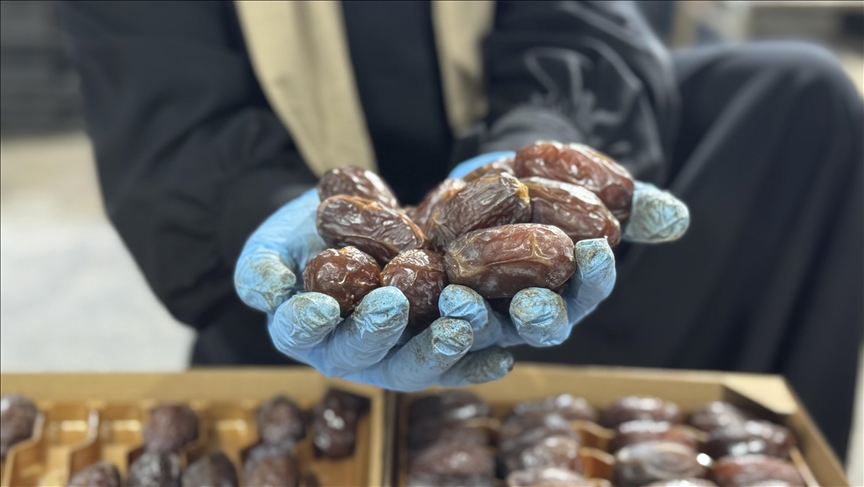
A significant portion of dates offered for sale in Europe are suspected to enter the market through third countries while hiding their true origin, reports Anadolu.
The rapid expansion of the global date trade and the complexity of supply chains have fueled debate over traceability and labeling transparency.
Israel, which is currently facing boycott campaigns, particularly in the Muslim world, is reported to have adopted strategies labeling to mitigate the impact of the consumer boycott in Europe.
The global date market, valued at $32.7 billion in 2025, is projected to grow to $34.5 billion in 2026, at an average annual growth rate of 6.14 percent. The market is expected to reach $55.58 billion by 2034.
The Middle East and Africa region maintains a dominant position, with annual production capacity exceeding nine million tons. This region accounted for 85.28 percent of the global market in 2025. The market size in the region grew from $27.89 billion in 2025 to $29.43 billion in 2026.
Top producers and consumers in the region include Tunisia, Iran, Israel, Saudi Arabia, the United Arab Emirates, Iraq, and Egypt.
Egypt is ranked as the largest producer in the world, with over 1.7 million tons per year. Saudi Arabia follows with more than 1.5 million tons, Iran with over 1.3 million tons, and Algeria with more than 1.1 million tons.
Although Israel lags behind Egypt and Saudi Arabia in total production volume, it continues to be an important player in exports of high-value-added dates, especially the premium Medjool type.
However, discrepancies between the figures of production and export have raised questions about the traceability of the supply chain.
Various industry reports, media investigations and European consumer protection organizations suggest that dates produced in Israeli settlements in the occupied West Bank can be marketed with labels that hide their origin, to circumvent boycott measures and regulatory scrutiny.
– The debate on transparency in the supply chain supply
The claims center on settlement-produced dates that are shipped to Europe through intermediary countries or indirect logistics channels, rather than direct export.
Products originating in the West Bank are allegedly labeled simply as “Israeli product” or presented as originating from neighboring countries when entering the European Union (EU) market.
Some exporters are said to repackage the goods in free trade zones. or pass them through intermediary countries, hiding the place of production.
With growing sensitivity in Europe to ethical sourcing and fair trade, concerns have been raised that hidden-origin labeling could mislead consumers and potentially breach trade regulations.
Experts say such practices could intensify during Ramadan, when demand peaks. Increased demand, they add, could put pressure on control mechanisms and distort competition.
According to World Bank data, about half of the dates sold in the Netherlands and more than a third in France are of Israeli origin.
Experts point out that both countries function as packing and re-export centers within Europe, with products further distributed to other countries in the world. EU, including Germany.
Products linked to Israel are estimated to account for approximately 25 percent of the total supply of dates in Germany.
– Claims to “cleanse” the origin of dates
Premium Medjool dates are at the center of debates over the origin of the products.
According to the Center for the Promotion of Imports from Developing Countries (CBI), about 50 percent of Medjool dates exported to Europe come from Israel. International food trade publications suggest this figure could be as high as 75 percent.
Critics argue that some of these exports may come from plantations in Israeli settlements in the West Bank, while origin labeling is not always clear.
Israel exports approximately 35,000 tons of dates per year. However, according to the Israeli agricultural magazine “Lahaklai”, sector data shows that only about 8,800 tons are produced within Israel’s internationally recognized borders, mainly in the Arava Valley.
If these figures are correct, it would mean that about 75 percent of the exported volume could originate from settlements in the West Bank, which are widely considered illegal under international law.
Several related companies with Israel are suspected of concealing the location of production when exporting these dates.
The term “date cleaning” is used by critics to describe practices where dates produced in the settlements are marketed with alternative labels of origin, including the Netherlands, Morocco, the United Arab Emirates or Palestine.
Some sector representatives claim that products from the settlements are mixed into Palestinian supply chains through middlemen. Others say that discrepancies between official declarations and real supply volumes enable the export of settlement-origin products under Palestinian branding.
Palestinian authorities have taken action before. In 2014, the Palestinian Ministry of National Economy reported the seizure of 20 tons of Israeli dates intended to be sold as a “Palestinian product.” Similar investigations have also been reported in subsequent years.
The EU implements specific labeling requirements for products originating from Israeli settlements.
According to a decision of the EU Court of Justice in 2019, labeling products from the settlements only as “Israeli product” is considered insufficient, the origin from the settlements must be clearly indicated to avoid consumer deception.
Experts call on European consumers to carefully verify information on origin when purchasing dates and demand more transparency for products that pass through intermediary countries or carry unclear regional labels.
Meanwhile, the Israeli agricultural sector is reportedly facing significant difficulties due to boycott campaigns and logistical disruptions related to the conflict in Gaza.
Israeli producers, according to Israeli media, have warned that the sector is approaching collapse.
Consumer activism and pressure in European markets, traditionally among the biggest destinations for Israeli exports, have prompted some retailers to review supply policies.
The UK-based Co-op has stopped supplying from Israel, while boycott campaigns have gained ground in countries such as Belgium and Ireland.
We use cookies to improve the experience and display ads (Google AdSense).
By clicking “Accept”, you agree to the use of cookies according to
Privacy Policy
and
Cookies Policy.
You can reject non-necessary cookies by clicking “Reject”.
Source: prizrenpost
Etiketa: Brief