Wednesday, June 3rd 2026
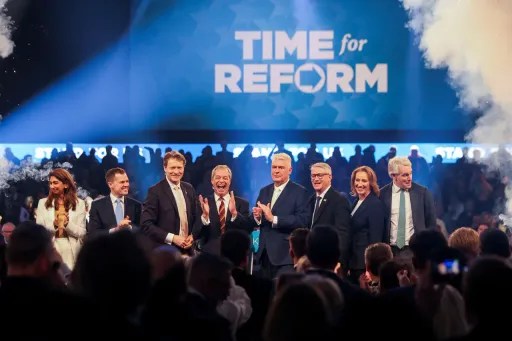
Fadeela* watched in horror as the number in the blue box representing the British far-right Reform party continued to grow on her TV screen. She checked who had won in her area, in the North London suburb of Whetstone: a Conservative councilor and a Labor councillor.
By the time the results were finalized in May, Reform had won control of 14 councils, with 1,454 of its councilors now holding positions of power in local authorities, more than any other political party. They were the undisputed winners of May’s UK local elections.
For years, the idea that this far-right populist party, founded in 2018 by former UKIP leader Nigel Farage – a man known for his hyper-nationalism – could win an election seemed implausible. But the May results were concrete proof that the opinion polls were correct. For the last two years, “Reform” has steadily gained popularity; according to YouGov polls, if Britain held a General Election now, “Reform” would win.
Former Secretary General of the Muslim Council of Britain and diversity and inclusion consultant, Zara Mohammed, tells TRT World that the results are a stark reminder of what could happen in the next general election. “It really speaks to a sense of how fed up people are, but also how completely divisive our politics are,” she says. “Reform has won so many victories that the future has changed, whether we like it or not”.
With Reform’s proposed policies, including scrapping indefinite leave to remain, repealing the Equality Act 2010 (a piece of legislation designed to protect people from all forms of discrimination) and restricting immigration, people like Fadeela are worried about what this could mean for their status as residence.
The 38-year-old Franco-Tunisian, a mother who works in publishing, has an unlimited residence permit in the country. Her husband and three children are British; however, this did not automatically entitle him to British citizenship. The recent success of “Reform” in the local elections has made her worry that if they win the next General Election, scheduled for 2029, and carry out their plan to end the unlimited residence permit, she may find herself forcibly separated from her family.
“I had put off applying for British citizenship because it is an expensive process,” she tells TRT World. “But the rise of Reform has been a motivator to do it. I’ve seen cases where people who don’t have a UK passport have been unable to re-enter the country. I feel this could be reinforced with the Reform party coming to power”.
It’s not just Muslim migrants who feel, after the local elections, that their future in Britain is uncertain. British Muslims are deeply concerned that a “Reform” government would enable anti-Muslim sentiment.
This was most recently evident at the “Unite the Kingdom” rally in London on May 16, organized by well-known anti-Islam and far-right figure Tommy Robinson. A recent POLITICO poll found that one in three Reform voters had a positive view of Robinson, showing a link between racism, Islamophobia and the Reform party.
This racism and Islamophobia extends from Reform voters to the highest levels of party politicians. Reform leader Farage has been targeted several times for Islamophobic remarks.
In his first 2024 election interview with Sky News, he claimed that 46 percent of British Muslims support Hamas and do not share British values, and as recently as March, Farage called a public Ramadan event in central London a “deliberate and willful attempt … to paraded, intimidated and dominated our way of life” and that he would like to see such events banned in the future.
“While Reform will say, ‘We are not racist,’ the rhetoric they are feeding is what is fueling that kind of hostility on the streets,” Assistant Secretary General of the Muslim Council of Britain, Naomi Green, tells TRT World. “The number of reports I’m hearing from Muslims just walking down the street and being told things because they wear a hijab or have a beard has never been the case before.”
This anti-Muslim discourse seeps down to the level of councilors – the same councilors elected in last month’s election who now hold power in local authorities.
A number of racist and Islamophobic posts were recently found on Brett’s social media accounts. Muscroft, now a Reform councilor in the Wakefield constituency of Castleford and Glasshoughton, along with open support for Tommy Robinson. In May, Reform deputy leader Richard Tice refused to condemn comments by Reform party councilor Glebb Gibbins, who in 2024 tweeted that Nigerians should be melted down and used to fill potholes. Gibbins has since been suspended.
Other newly elected Reform councilors have also been suspended or resigned over similar comments. Stuart Prior, who resigned days after the election, is said to have called Muslims ‘dirt’ and, in another post, wrote: “There can be no genocide against Muslims. It’s always just self-defense against those rats.” Knowing that some of their elected councilors hold such hateful views leaves many Muslims in Britain anxious.
“Many Muslims have to use local authorities because of our faith, for funerals, planning permission and local services for mosque community centres,” Mohammed told TRT World. “So there’s a lot of engagement between local authorities and Muslim communities. Muslims will be worried about how they’re going to navigate that. The idea that they [Reform] have so much representation on councils, I think Muslims are absolutely horrified at the idea that there could be a Reform government.” “Reform” did not respond to TRT World’s requests for comment.
Siddique Patel’s family has lived in Dewsbury for generations. The family lawyer closely follows local and national politics. While independent candidates won in his Dewsbury West constituency, on the other side of town in Dewsbury East, Reform won, reflecting the increasingly polarized politics in the West Yorkshire town. Last summer, Dewsbury East was the site of a major community effort to raise St George’s flags on public lampposts as part of the far-right movement ‘Operation Raise the Colours’.
“I worry about my children’s future,” says Patel. “I want my children to grow up in a place where they feel safe and feel part of the country. They are British Muslims; they were born in this country. We are fourth generation Muslims, so we are established here”.
Patel says that when political leaders normalize Islamophobic rhetoric, it sends a signal that such behavior is acceptable, allowing hatred and division to spread more easily in society. He adds that the language used by many Reform advisers risks creating an environment where Muslim families, including his own children, no longer feel safe.
While Patel worries about what a Reform-controlled Britain will mean for his children, he is adamant that Britain is their home and that he is not going anywhere. “This is our country and we have contributed to it,” he says. “We want this country to do well and we want to show people the beauty of our faith through our actions. However, for other British Muslims, as the possibility of Reform becoming the next government becomes real, moving to another country or making hijra (emigration) to Turkey, Malaysia or the Persian Gulf is now on the cards.”
Occupational therapist Amina Tracy Siddall, who lives in a village in the north-east city of Durham where “Reform” won, repeats this. “I would be here until I could move to another Muslim country,” she tells TRT World. “Otherwise, I don’t think I could move anywhere else in England that would be better.”
Fadeela and her husband are keeping their options open. “We are 100 percent thinking about our exit plan,” she tells TRT World. “We are thinking of moving to other countries where there is less hatred towards Muslims. It could be another European country, a country in North Africa or somewhere like Singapore”.
Source: prizrenpost
Etiketa: Brief