Saturday, August 8th 2026
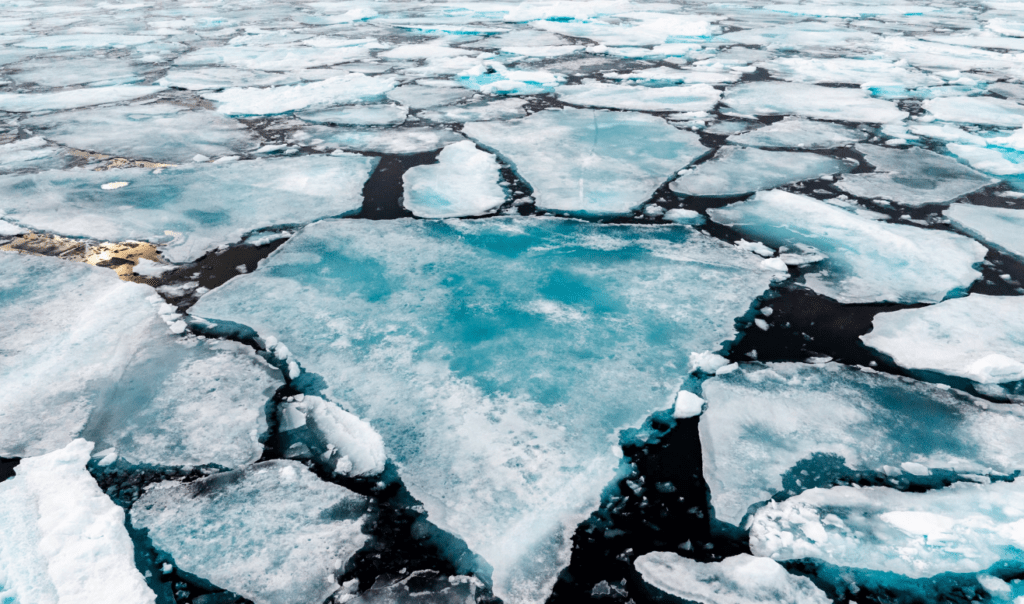
The slowdown in Arctic ice melt seen in recent years has come to an end. A new study shows the largest annual decline in winter ice since satellite measurements began, reports The Guardian.
In a study published last summer, scientists found that the melting of Arctic sea ice had slowed over the past 20 years. According to the data, between 2005 and 2024, no statistically significant decrease in ice surface was observed.
This result was considered unusual, as during the same period global temperatures continued to rise.
The researchers explained that natural changes in ocean currents, which temporarily limit ice melting, had balanced the effect of global warming. However, they warned that this was only a temporary phenomenon and that melting would resume at an even faster rate within 5 to 10 years.
Just two years later, the latest study confirms that this slowdown has already ended.
Analyzing the latest satellite data, the researchers concluded that the period 2005–2024 represented only a temporary pause, and not a change. long-term trend.
The main author of the study, Dr. Duo Chan from the University of Southampton, said that what in the early 2020s looked like a melting halt, now turns out to have been only a temporary slowdown in a long-term trend of ice loss.
According to the researchers, the extent of sea ice in September, when it reaches its lowest annual level, has halved since 1979, when satellite measurements began.
The study reveals that from 2024 to 2025, the Arctic sea ice area shrank by 5.8%, marking the largest year-over-year winter decline in recorded history.
Study co-author Dr. Alessandro Silvano, pointed out that this sharp drop was unusual, but entirely possible in the conditions of the continued warming of the Arctic.
Scientists warn that the winter ice plays a vital role as an insulator between the relatively warm Arctic ocean and the much colder atmosphere. As it decreases, more heat and moisture pass into the atmosphere, affecting atmospheric pressure patterns, the development of storms and the circulation of air masses.
These changes can affect the weather even in regions far away from the Arctic.
According to Dr. Chan, the study is another alarm signal for the climate crisis.
“Short-term recoveries may temporarily hide the long-term trend of ice loss in the Arctic. The very low levels of winter ice during 2025 and 2026 clearly show that ice loss has not stopped, but is continuing in a steadily warming climate.”
Source: prizrenpost